
Permanent Establishment in US Canadian Tax Treatment Why It Matters for Cross Border Business
I first became familiar with the concept of "Permanent Establishment" when I was part of the litigation team that tried Taisei Fire & Marine Insurance Co., Ltd. v. Commissioner, 104 T.C. 535 (1995). The case was about whether economic control could result in a permanent establishment and taxation, even without direct ownership of the company.
A company can sell across the US-Canada border for years and still miss the tax issue that changes everything: whether it has created a permanent establishment in the other country.
That term sounds technical, but the business impact is practical. It can affect where profits are taxed, what returns must be filed, how contracts are structured, and whether a “simple” expansion has quietly become a taxable presence.
For companies doing business in both Canada and the US, permanent establishment is one of the first treaty concepts to understand. It does not answer every tax question, and it does not replace state, provincial, payroll, sales tax, or GST/HST analysis. Still, it often determines whether cross-border business profits can be taxed in the other country under the Canada-US tax treaty.
This article is for general information only and is not legal or tax advice. Cross-border facts can change the outcome quickly, so specific guidance matters.
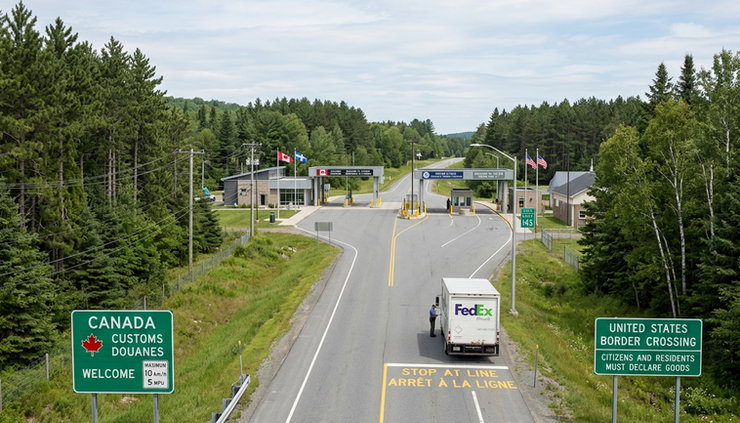
What permanent establishment means under the Canada-US tax treaty
Permanent establishment, often shortened to PE, is a treaty concept. Under the Canada-US tax treaty, business profits of a resident of one country generally are taxable in the other country only if the business carries on activity there through a permanent establishment. If there is a PE, the other country may tax the profits attributable to that PE.
In plain terms, PE asks:
Has the business crossed the line from merely selling into another country to carrying on business there in a substantial enough way to justify income tax?
The treaty does not treat every sale, visit, or customer relationship as a PE. A Canadian company may sell to US customers without automatically having a US PE. A US company may serve Canadian clients without automatically having a Canadian PE.
But certain facts can create one.
Common types of permanent establishment include:
A fixed place of business in the other country
A branch, office, factory, or workshop
A place of management
A mine, oil or gas well, quarry, or other place of natural resource extraction
A building site or construction or installation project that lasts long enough under the treaty
Certain dependent agent arrangements
Certain service activities performed in the other country for enough time
The analysis is fact-specific. Labels do not control the result. Calling someone an “independent contractor” does not automatically prevent PE. Calling a location a “storage space” does not automatically make it harmless. Tax authorities look at what actually happens.
That is why Permanent Establishment in US Canadian Tax Treatment Why It Matters for Cross Border Business is not just a treaty phrase. It is a planning issue that should be reviewed before operations expand, not after a filing problem appears.
The main ways a business can create a permanent establishment
A PE can arise in several ways. The most common issues involve physical locations, people with authority, construction projects, and services performed across the border.
A fixed place of business can create a PE
A fixed place of business is one of the clearest PE risks. This usually means the business has a location in the other country that is:
Physically present
Relatively fixed or ongoing
Available to the business
Used to carry on its business activities
Examples may include a branch, office, workshop, or factory. A warehouse or storage location may require closer analysis, especially if employees or contractors use it for more than storage or delivery.
A Canadian manufacturer that leases space in Michigan to repair products for US customers may have a US PE if the space is used regularly to conduct core business activities. A US software company that rents a small facility in Ontario where staff provide customer implementation services may face a Canadian PE issue.
The key question is not only whether a location exists. The question is what the business does there.
Some activities may fall under treaty exceptions if they are preparatory or auxiliary. For example, a facility used only for storage, display, or delivery may not create a PE in some cases. But that exception can narrow quickly if the location supports sales, service, management, production, or other essential business functions.

A dependent agent can create a PE without a company location
A business does not always need its own premises to create a PE. A person in the other country can create one if that person acts on behalf of the business and habitually exercises authority to conclude contracts in its name.
This is often called a dependent agent PE.
For example, a Canadian company may not have a US office, but it may have a US-based representative who regularly negotiates and finalizes customer contracts. If that person is economically and legally dependent on the Canadian company, and routinely binds the company, the arrangement may create PE risk.
The same issue can arise when a US company uses a Canadian representative to close deals with Canadian customers.
Independent agents are treated differently. If a broker, commission agent, or other agent acts in the ordinary course of an independent business, the PE risk may be lower. But independence has substance. If the agent works almost entirely for one foreign company, follows detailed instructions, and bears little business risk, the “independent” label may not hold.
Construction and installation projects have treaty timing rules
Construction, building, and installation projects receive special treatment under the treaty. A project does not usually create a PE from day one. Under the Canada-US treaty, a building site or construction or installation project generally must last more than 12 months before it becomes a PE.
This rule matters for contractors, engineering firms, equipment installers, and companies that send teams across the border for long projects.
A US contractor working on a Canadian installation project for three months may have a different treaty position than one working on a connected project for 14 months. Breaking a project into separate contracts does not always solve the issue if the work is commercially connected.
The practical concern is timing. Once the project approaches the treaty threshold, the tax result may change.
Services performed across the border can also create PE risk
The Canada-US treaty includes rules that can create a PE from certain services performed in the other country, even without a traditional office or branch.
These service PE rules are especially relevant for consultants, engineers, technology implementation teams, professional service providers, and companies that send personnel across the border for extended work.
In broad terms, a service PE issue may arise when individuals perform services in the other country for long enough during a 12-month period and meet the treaty’s conditions. One rule looks at an individual’s presence for 183 days or more in a 12-month period where certain revenue conditions are met. Another can apply to services provided for the same or connected projects for customers in the other country over a long enough period.
The exact test is technical, but the business lesson is simple: days matter. So do the customer, project, revenue, and location of the work.
A company that sends staff across the border “just for implementation” or “just for support” should track days carefully. Short visits can add up.
Why permanent establishment matters to cross-border businesses
The PE analysis matters because it can change tax obligations in a real way. It is not just a theoretical treaty issue.
It may determine whether business profits are taxable in the other country
If there is no PE, the treaty may protect business profits from income tax in the market country. For example, if a Canadian company sells into the US but has no US PE, the US may be limited in its ability to tax those business profits under the treaty.
If there is a PE, the market country may tax the profits attributable to that PE. That does not mean all worldwide profits become taxable there. The issue is attribution. The business must determine what income and expenses relate to the PE.
This can require careful accounting. Revenue, employee functions, assets used, risks assumed, intercompany charges, and support costs may all matter.
It can trigger tax filings even when no tax is due
PE status can also affect filing obligations. A company may need to file a return in the other country to claim treaty protection, report PE income, or preserve a tax position.
A Canadian company with US activity may need to consider US federal tax filings, treaty disclosure, and potentially state filings. A US company with Canadian activity may need to consider Canadian tax filings and related reporting.
Even where treaty protection applies, tax authorities often expect clear documentation. Ignoring filings because “we do not owe tax” can create penalties, missed elections, or problems during diligence.
It affects withholding, payroll, and indirect tax conversations
Permanent establishment is an income tax treaty concept, but cross-border tax does not stop there.
A business with people working in the other country may also face payroll tax, employer reporting, immigration, and employment law questions. Sales taxes, use taxes, GST/HST, provincial sales taxes, and customs rules may apply even when there is no PE for income tax purposes.
This is a common trap. A company may correctly conclude that it has no PE, then incorrectly assume there are no other cross-border obligations.
PE is a central question, not the only question.
It matters during financing, sale, and due diligence
PE issues often surface when a company raises capital, seeks financing, sells the business, or goes through an audit. Buyers and investors pay attention to unfiled tax exposure.
If a company has years of activity in the other country without reviewing PE, due diligence may ask:
Did the company have people or agents in the other country?
Were contracts signed or negotiated there?
Did personnel spend significant time there?
Were there warehouses, repair sites, or project locations?
Were any treaty-based return positions filed?
Were profits properly attributed if a PE existed?
Clean records can reduce friction. Unclear facts can delay deals or reduce value.

Practical examples of PE risk in US-Canada operations
The following examples are simplified. Real outcomes depend on all facts and the treaty language.
A Canadian product company hires a US salesperson
A Canadian company sells industrial equipment to US customers. It hires a US-based salesperson who works from home, visits customers, negotiates pricing, and regularly signs contracts on behalf of the Canadian company.
There may be no US branch and no rented office. Still, the salesperson’s authority can create dependent agent PE risk. The company should review the contract process, decision-making authority, customer communications, and actual conduct.
If the salesperson only promotes products and all material terms are approved and contracts are concluded in Canada, the risk may be lower. But the facts must support that position.
A US technology company sends staff to Canada for implementation
A US software company signs a contract with a Canadian customer. Its employees travel to Canada for implementation, testing, and training. The work stretches across many months, with several employees rotating in and out.
The company may focus on the fact that no Canadian office exists. That may not end the analysis. The service PE rules may require a day count and review of whether the work relates to the same or connected project.
If the Canadian work becomes extensive, the company should review whether Canadian income tax filings are needed and whether payroll or GST/HST obligations arise.
A Canadian manufacturer uses a US warehouse
A Canadian manufacturer stores finished goods in a US warehouse operated by a third-party logistics provider. The warehouse stores, packs, and ships products to US customers. The manufacturer has no employees there.
This may be lower risk if the activity is limited to storage and delivery, especially if the logistics provider acts independently. But risk rises if the facility becomes a place where repairs, customization, customer service, or sales activity occur.
The warehouse agreement, control over space, employee access, and activities performed all matter.
A US contractor takes on a long Canadian installation project
A US contractor installs specialized equipment at a Canadian facility. The project is expected to take 10 months, but delays push it beyond 12 months.
The treaty’s construction and installation project rule may become central. The company should monitor timeline changes and review whether connected phases count together.
Waiting until the project ends can leave too little time to manage filings, payroll, and profit attribution.
How businesses can manage permanent establishment risk
PE risk cannot always be avoided, and avoiding it is not always the right goal. Sometimes a PE is the natural result of expansion. The real goal is to know the answer early and plan around it.
Map the cross-border facts before expansion
Start with the facts, not the tax conclusion. A useful PE review usually gathers:
Where employees and contractors work
How many days personnel spend in the other country
Who negotiates and approves contracts
Where contracts are signed or accepted
What facilities, warehouses, or project sites are used
What activities occur at each location
Which customers and projects generate cross-border revenue
Whether agents are independent in substance
This map helps tax advisors test the facts against the treaty.
Track days and activities
Day counting is essential for service businesses, construction teams, and companies with frequent travel. Calendar records, travel logs, project files, and expense reports can support the company’s position.
The records should show more than presence. They should show what people did while they were there. A sales visit, service visit, installation day, and management meeting may be treated differently.
Align contracts with actual operations
Contracts should match the way the business works. If a company says that contracts are approved in Canada, but US personnel routinely finalize key terms and bind the company, the documents will not carry the position.
Useful contract controls may include:
Clear limits on who can bind the company
Approval procedures for pricing and material terms
Written roles for agents and contractors
Separation between promotion and contract conclusion where appropriate
Documentation of where acceptance occurs
The goal is not paper-only compliance. The operations must follow the documents.
Decide whether registration and filing are needed
If a PE exists, the business should address filing, payment, and reporting obligations. If no PE exists but the facts are close, the business may still need protective filings or treaty disclosures.
This is also the right time to review related issues such as transfer pricing, intercompany service charges, withholding tax, payroll, and sales tax. Cross-border tax questions often connect.

The takeaway for companies doing business in both countries
Permanent establishment is where cross-border ambition meets tax reality. A company can create tax presence through a location, a person, a long project, or services performed across the border. The result can affect income tax, filings, profit attribution, and deal readiness.
The best time to review PE is before hiring across the border, signing a major customer, opening a warehouse, starting a construction project, or sending staff for months of service work. The second-best time is before the facts become hard to reconstruct.
For US and Canadian businesses, the practical approach is simple: document where work happens, track who has authority, monitor days in the other country, and review treaty positions before growth turns into exposure.


Comments